

Enzyme kits for polyphosphate research
Enzyme kits for polyphosphate research
Measure polyphosphate concentration and chain length.
Measure polyphosphate concentration and chain length.
Phosfinity Quant quantifies total polyP in any sample. Phosfinity ChainQuant does the same and adds average chain length. Both run on a standard 96-well plate reader, in about an hour, with all enzymes, reagents, and standards included.
Ensure consistent, high-precision results every time. Designed for reliable performance across diverse research and industrial workflows.
Trusted by research groups at
Trusted by research groups at



Complete Polyphosphate Analysis Platform
Complete Polyphosphate Analysis Platform
Analysis of the two key numbers
Analysis of the two key numbers
Polyphosphates (polyP) are linear polymers of orthophosphate residues linked by high-energy bonds. Knowing how much is in your sample is only half the picture.
Polyphosphates (polyP) are linear polymers of orthophosphate residues linked by high-energy bonds. Knowing how much is in your sample is only half the picture.

What Are Polyphosphates?
What Are Polyphosphates?
Polyphosphates (polyP) are linear polymers of orthophosphate residues linked by high-energy phosphoanhydride bonds. Found in bacteria, blood, soil, and plants.
Polyphosphates (polyP) are linear polymers of orthophosphate residues linked by high-energy phosphoanhydride bonds. Found in bacteria, blood, soil, and plants.

Why Measure Concentration?
Why Measure Concentration?
Quantifying total polyP reveals phosphate reserves, metabolic states, and key biological processes accurately and reliably — the most fundamental measurement.
Quantifying total polyP reveals phosphate reserves, metabolic states, and key biological processes accurately and reliably — the most fundamental measurement.

Why Measure Chain Length?
Why Measure Chain Length?
Chain length determines polyP function: short chains serve as phosphate donors, while long chains act as energy stores and chelators. Identical concentration, very different biology.
Chain length determines polyP function: short chains serve as phosphate donors, while long chains act as energy stores and chelators. Identical concentration, very different biology.
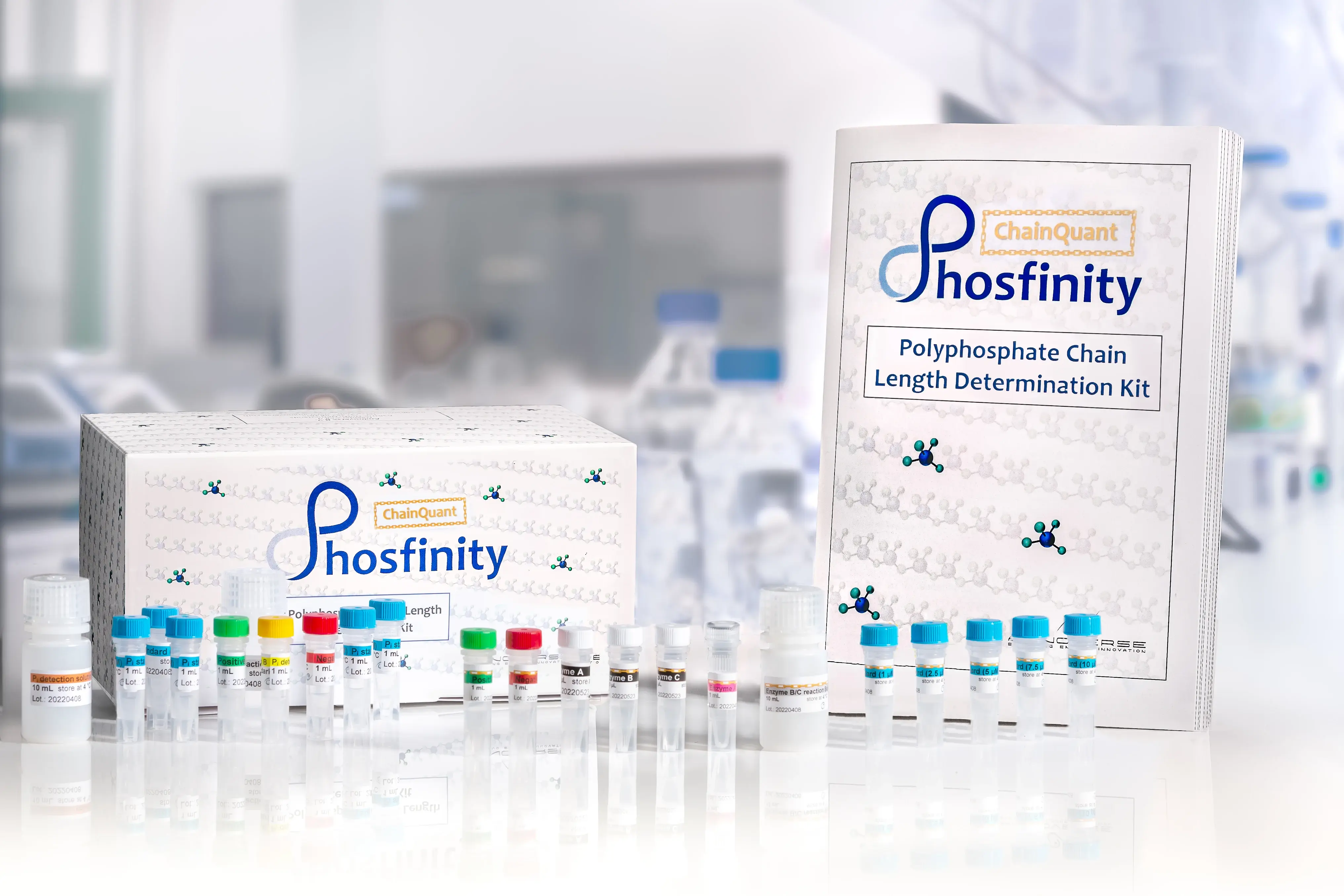
Phosfinity Quant
Phosfinity Quant
How much polyP?
How much polyP?

Chain length
Chain length
How long are the chains?
How long are the chains?

Phosfinity ChainQuant
Phosfinity ChainQuant
Both, in one workflow
Both, in one workflow
ChainQuant does everything Quant does, and adds average chain length.
ChainQuant does everything Quant does, and adds average chain length.
You never need both kits to get both numbers; just choose the kit that answers your question.
You never need both kits to get both numbers; just choose the kit that answers your question.
Our Products
Our Products
Two complementary enzyme-based kits delivering complete polyphosphate insight from concentration to chain length
Two complementary enzyme-based kits delivering complete polyphosphate insight from concentration to chain length


PHOSFINITY QUANT
PHOSFINITY QUANT
Polyphosphate Quantification Kit
The gold standard for research-grade polyphosphate quantification. Enzymatic degradation to orthophosphate, detected colorimetrically at 882 nm. No enzyme purification, no daily reagent preparation.
The gold standard for research-grade polyphosphate quantification. Enzymatic degradation to orthophosphate, detected colorimetrically at 882 nm. No enzyme purification, no daily reagent preparation.
WHY LABS SWITCH TO IT
WHY LABS SWITCH TO IT
Reproducible between operators and between days eliminates the variability of self-prepared assays
Reproducible between operators and between days eliminates the variability of self-prepared assays
100 reactions per kit; up to 100 samples measured in a single pass
100 reactions per kit; up to 100 samples measured in a single pass
~1 hour at room temperature, start to result
~1 hour at room temperature, start to result
200 µL sample volume at 100 µM polyP as monomer
200 µL sample volume at 100 µM polyP as monomer
ATP, DNA, RNA and NaCl do not interfere with the measurement
ATP, DNA, RNA and NaCl do not interfere with the measurement
Positive and negative controls included; free Excel analysis sheet
Positive and negative controls included; free Excel analysis sheet
TYPICAL USE
Checking polyP extraction yield from blood, soil, water, plants and microorganisms
Checking polyP extraction yield from blood, soil, water, plants and microorganisms
Screening strains or conditions for polyP accumulation
Screening strains or conditions for polyP accumulation
QC on chemically produced polyP
QC on chemically produced polyP
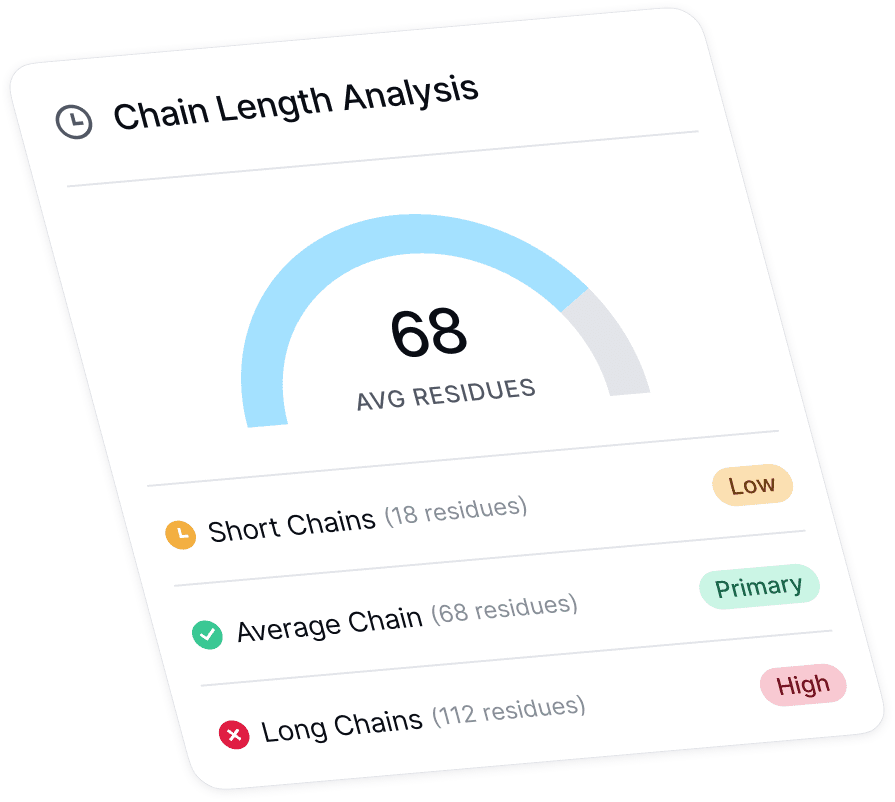
PHOSFINITY CHAINQUANT
PHOSFINITY CHAINQUANT
Polyphosphate Chain Length Analysis Kit
The world's first research-grade kit for accurate polyphosphate chain length analysis and concentration measurement, both values, one workflow.
The world's first research-grade kit for accurate polyphosphate chain length analysis and concentration measurement, both values, one workflow.
WHY CHAIN LENGTH CHANGES YOUR CONCLUSION
WHY CHAIN LENGTH CHANGES YOUR CONCLUSION
Differentiating chain length is critical: size, not concentration, defines polyphosphate’s specific biological activity.
Differentiating chain length is critical: size, not concentration, defines polyphosphate’s specific biological activity.
Returns chain length and concentration values from one 96-well workflow, no additional steps
Returns chain length and concentration values from one 96-well workflow, no additional steps
Quantification range 5–200 µM polyP as monomer, irrespective of chain length
Quantification range 5–200 µM polyP as monomer, irrespective of chain length
Validated on blood, soil, plant, microbial and water samples
Validated on blood, soil, plant, microbial and water samples
200 µL sample volume; same plate reader, same ~1 hour run
200 µL sample volume; same plate reader, same ~1 hour run
TYPICAL USE
TYPICAL USE
Characterising polyP produced by polyphosphate kinase variants
Characterising polyP produced by polyphosphate kinase variants
Comparing chain length across strains, growth phases or process conditions
Comparing chain length across strains, growth phases or process conditions
Specifying and verifying chain length in industrial polyP production
Specifying and verifying chain length in industrial polyP production
Which Kit Do You Need?
Which Kit Do You Need?
Side-by-side comparison
Side-by-side comparison

How it works
How it works

1. Sample & Preparation
1. Sample & Preparation
Collect and prepare samples from diverse biological and environmental sources blood, soil, water, plants, microorganisms.
Collect and prepare samples from diverse biological and environmental sources blood, soil, water, plants, microorganisms.

2. Polyphosphate Analysis
2. Polyphosphate Analysis
Measure concentration and chain length using Phosfinity Quant and ChainQuant kits on a standard 96-well plate reader.
Measure concentration and chain length using Phosfinity Quant and ChainQuant kits on a standard 96-well plate reader.

3. Scientific Insights
3. Scientific Insights
Generate reliable, reproducible data to support research conclusions and informed decisions.
Generate reliable, reproducible data to support research conclusions and informed decisions.
Applications
Applications
Where Phosfinity kits are used
Where Phosfinity kits are used
Phosfinity kits are used across a wide range of research and industrial applications involving polyphosphate analysis.
Phosfinity kits are used across a wide range of research and industrial applications involving polyphosphate analysis.

Microbiology
Study polyphosphate metabolism in bacterial systems and microbial communities. Screen strains for polyP accumulation.
Study polyphosphate metabolism in bacterial systems and microbial communities. Screen strains for polyP accumulation.

Enzymology
Analyse enzyme activity related to polyphosphate synthesis and degradation. Characterise kinase variants by chain length output.
Analyse enzyme activity related to polyphosphate synthesis and degradation. Characterise kinase variants by chain length output.

Industrial Biotechnology
Monitor polyphosphate processes in fermentation and bioproduction systems. Specify and verify chain length in manufactured polyP.
Monitor polyphosphate processes in fermentation and bioproduction systems. Specify and verify chain length in manufactured polyP.

Environmental Research
Investigate polyphosphate roles in soil, water, and ecological systems. Compatible with complex sample matrices.
Investigate polyphosphate roles in soil, water, and ecological systems. Compatible with complex sample matrices.

Academic Research
Support fundamental research across universities and research institutes. Cited in peer-reviewed publications.
Support fundamental research across universities and research institutes. Cited in peer-reviewed publications.

Pharma & Life Sciences
Enable advanced research in cellular processes, metabolic pathways, and blood coagulation involving polyphosphates.
Enable advanced research in cellular processes, metabolic pathways, and blood coagulation involving polyphosphates.
Why Phosfinity
Why Phosfinity
Phosfinity was co developed with Prof. Dr. Lars M. Blank and Dr. Jonas J. Christ of the institute of Applied Microbiology at RWTH Aachen, two of the field's authorities of polyP analytics.
Phosfinity was co developed with Prof. Dr. Lars M. Blank and Dr. Jonas J. Christ of the institute of Applied Microbiology at RWTH Aachen, two of the field's authorities of polyP analytics.

REPRODUCIBILITY
REPRODUCIBILITY
Pre-validated enzyme reagents, positive and negative controls in every kit, and a free Excel analysis sheet so every lab calculates results the same way.
Pre-validated enzyme reagents, positive and negative controls in every kit, and a free Excel analysis sheet so every lab calculates results the same way.
SCIENTIFIC RIGOUR
SCIENTIFIC RIGOUR
Used at research institutions across Europe, North America and Oceania. Cited in peer-reviewed publications. The gold standard for polyP quantification.
Used at research institutions across Europe, North America and Oceania. Cited in peer-reviewed publications. The gold standard for polyP quantification.

SIMPLICITY
SIMPLICITY
Any lab with a standard 96-well plate reader can run Phosfinity. No need to purify your own enzyme reagents or prepare fresh solutions daily.
Any lab with a standard 96-well plate reader can run Phosfinity. No need to purify your own enzyme reagents or prepare fresh solutions daily.

EXPERT SUPPORT
EXPERT SUPPORT
Aminoverse scientists answer protocol questions directly. We help you adapt the assay to your specific sample matrix and research context.
Aminoverse scientists answer protocol questions directly. We help you adapt the assay to your specific sample matrix and research context.
Built on scientific expertise and trusted by leading research institutions
Built on scientific expertise and trusted by leading research institutions
Reliable calibration
High-resolution chain length

Validated against the gold standard
Validated against the gold standard
ChainQuant agrees with ³¹P NMR within 4% on average and significantly outperforms PAGE
ChainQuant agrees with ³¹P NMR within 4% on average and significantly outperforms PAGE
ChainQuant results align closely with both ³¹P NMR and end-group titration, while PAGE-based estimates diverge substantially from all three methods.
ChainQuant results align closely with both ³¹P NMR and end-group titration, while PAGE-based estimates diverge substantially from all three methods.
−4%
−4%
Avg. deviation vs. ³¹P NMR
Avg. deviation vs. ³¹P NMR
14%
14%
Avg. deviation vs. end-group titration
Avg. deviation vs. end-group titration
348%
348%
Avg. deviation of PAGE vs. ChainQuant
Avg. deviation of PAGE vs. ChainQuant
Testimonials
Testimonials
University of Stuttgart, Germany
Prof. Dr. Dieter Jendrossek

"The PHOSFINITY Quant kit is a time-saving alternative to self-prepared assays. Easy to use and ensures reproducible results."
"The PHOSFINITY Quant kit is a time-saving alternative to self-prepared assays. Easy to use and ensures reproducible results."


University of Alabama, USA
Prof. Dr. Michael J. Gray

The PHOSFINITY Quant kit is a huge advance for the field it lets labs make accurate and specific polyP measurements quickly without needing to purify their own enzyme reagents
The PHOSFINITY Quant kit is a huge advance for the field it lets labs make accurate and specific polyP measurements quickly without needing to purify their own enzyme reagents

Request a Quote
Request a Quote
Tell us about your research needs and our team will get back to you with the right Phosfinity solution, with pricing, lead time and any technical details you need.
Tell us about your research needs and our team will get back to you with the right Phosfinity solution, with pricing, lead time and any technical details you need.
Response within two business days
Response within two business days
Pricing and lead time included
Pricing and lead time included
Technical support from Aminoverse scientists
Technical support from Aminoverse scientists
Guidance on which kit fits your workflow
Guidance on which kit fits your workflow
*Phosfinity is not sold through an online checkout. Every quote is tailored to your research context. A Phosfinity specialist replies within two business days.
*Phosfinity is not sold through an online checkout. Every quote is tailored to your research context. A Phosfinity specialist replies within two business days.
Powered by Aminoverse
Powered by Aminoverse
Aminoverse develops and manufactures Phosfinity. As a CRO for enzyme projects, Aminoverse specializes in enzyme discovery, enzyme engineering, enzyme assay development, and enzyme production. With more than 6 years experience in the enzyme field the Phosfinity kits represent how Aminoverse turns validated assays into robust and ready-to-use kits.
Ensure consistent, high-precision results every time. Designed for reliable performance across diverse research and industrial workflows.
Every Phosfinity kit is backed by Aminoverse's enzyme production infrastructure and quality standards.
Ensure consistent, high-precision results every time. Designed for reliable performance across diverse research and industrial workflows.
Ready to discuss your research needs?
Get in touch with the team to request a tailored quote for Phosfinity Quant, ChainQuant, or both.
© 2026 Aminoverse. All rights reserved.
Ready to discuss your research needs?
Get in touch with the team to request a tailored quote for Phosfinity Quant, ChainQuant, or both.
© 2026 Aminoverse. All rights reserved.
Ready to discuss your research needs?
Get in touch with the team to request a tailored quote for Phosfinity Quant, ChainQuant, or both.
© 2026 Aminoverse. All rights reserved.